


Anreise
Der Kilimandscharo International Airport liegt nahe am Berg, und die Besteigung startet an einem Tor, etwa eine Autostunde von Moshi oder Arusha entfernt.

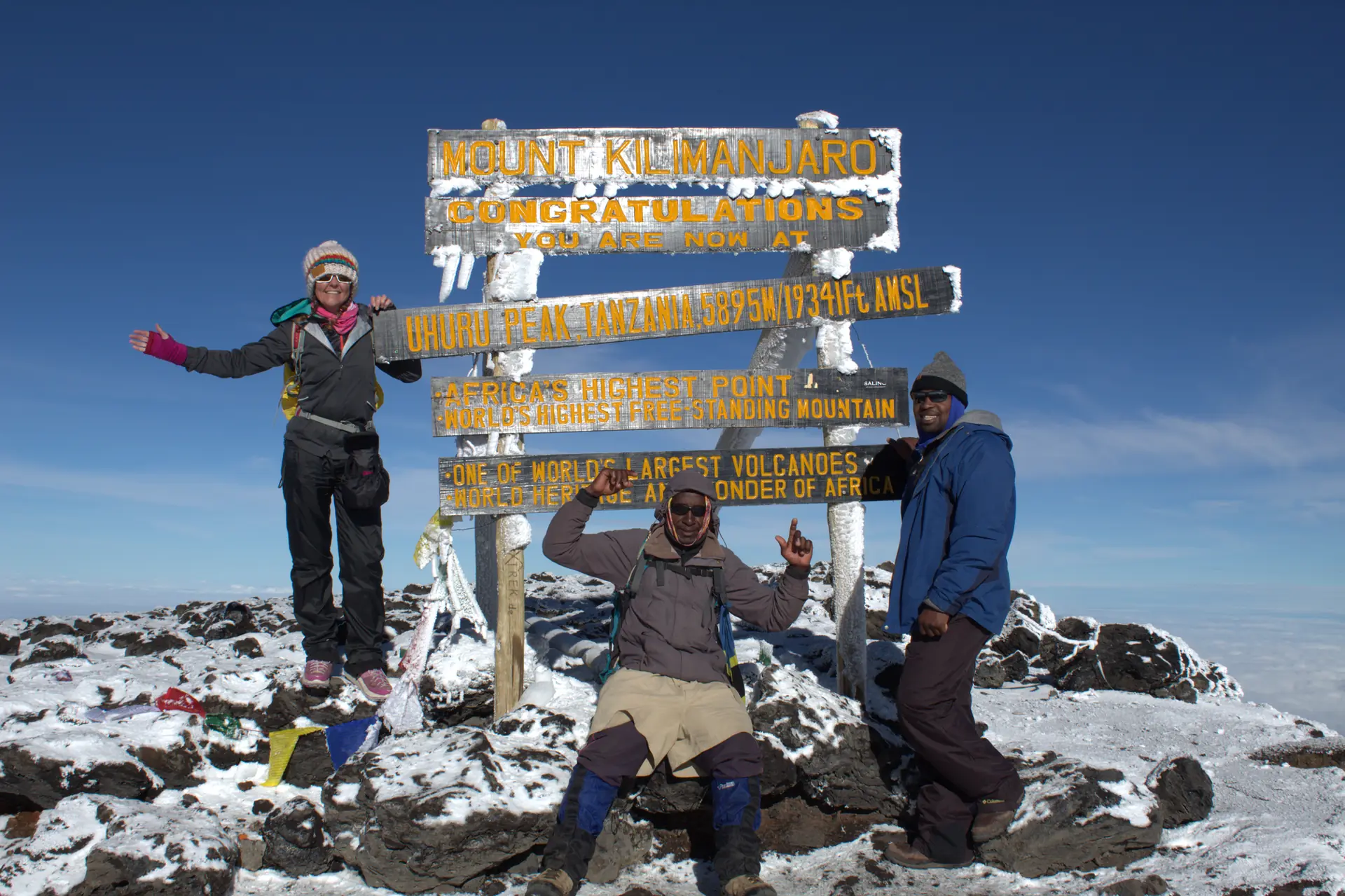
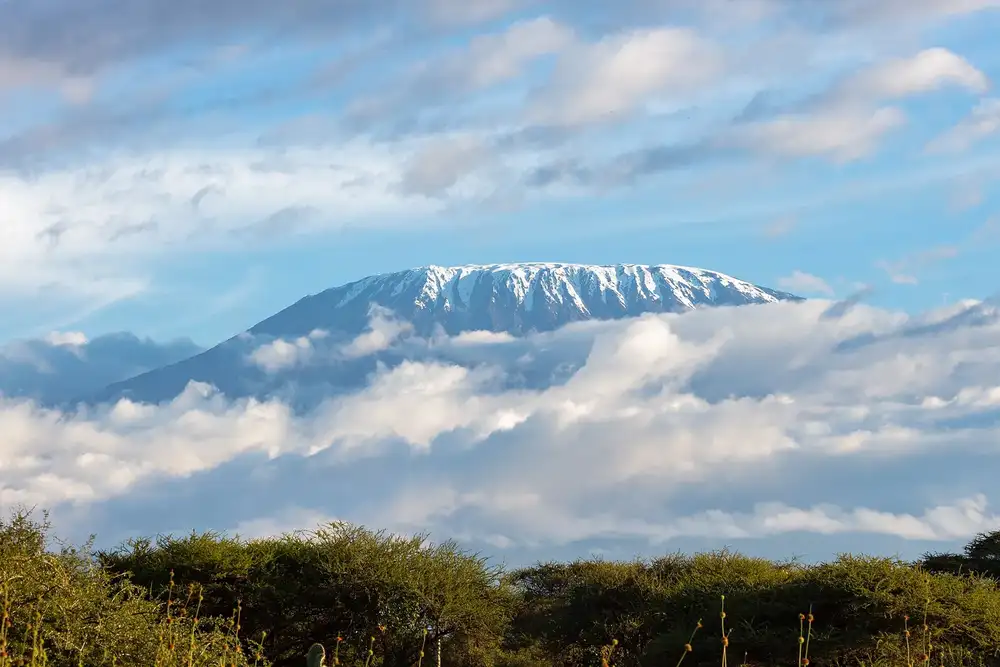
Afrikas höchster Berg mit 5.895 Metern und der größte freistehende Berg der Welt, mit einem Nationalpark von 75.675 Hektar.
Der Kilimandscharo ist mit 5.895 Metern Afrikas höchster Berg und der größte freistehende Berg der Welt. Sie können den Gipfel ohne technische Kletterkenntnisse erreichen, als langer Trek über mehrere Tage.
Der Aufstieg führt durch fünf Klimazonen, von Ackerland und Regenwald über Heide und alpine Wüste bis zum vergletscherten Gipfel.

Im Regenwald leben Diademmeerkatzen und Colobusaffen, Buschböcke und viele Vögel. Weiter oben wird die Landschaft ruhiger, und die Tierwelt beschränkt sich auf wenige anspruchslose Arten.

Januar bis Anfang März und Juni bis Oktober sind die Haupttrockenzeiten. Der Berg kann das ganze Jahr über bestiegen werden.
Vor und nach der Besteigung übernachten Sie in einem Hotel in Moshi oder Arusha. Am Berg schlafen Sie in Zelten, auf der Marangu-Route in Hütten.
Der Kilimandscharo International Airport liegt nahe am Berg, und die Besteigung startet an einem Tor, etwa eine Autostunde von Moshi oder Arusha entfernt.
Fünf bis neun Tage am Berg, je nach Route; längere Routen geben Ihnen mehr Zeit zur Höhenanpassung.
Unterkunft: Berglager, danach Lodges
Preis auf Anfrage
Reiseverlauf ansehenUnterkunft: Camping am Berg
Preis auf Anfrage
Reiseverlauf ansehenUnterkunft: Berghütten
Preis auf Anfrage
Reiseverlauf ansehenUnterkunft: Camping am Berg
Preis auf Anfrage
Reiseverlauf ansehenUnterkunft: Lodges und Zeltcamps
Preis auf Anfrage
Reiseverlauf ansehenUnterkunft: Hotel und Lodge am Kraterrand
Preis auf Anfrage
Reiseverlauf ansehenDas hängt von Ihrer Fitness, Ihrer Zeit und Ihrem Budget ab. In unserem Kilimandscharo-Bereich finden Sie einen Vergleich aller sechs Routen.
Erzählen Sie uns, was Sie vorhaben, und wir antworten mit ehrlicher Beratung und einem individuellen Angebot.
Dieser Text ist nur auf Englisch verfügbar.
At 19,340 ft., Kilimanjaro is the highest mountain in Africa and the largest free-standing mountain in the world. Surrounding the base of this huge dormant volcano is tropical montane forest rich with unique flora and fauna. Further up, heath forest opens into a moorland dotted with giant senecio and lobilia. A magnificent zone of rock and ice leads to the summit crater where sulfur gas still emits from the ash pit. Just above the crater floor is Uhuru Peak, the mountain’s true summit.
Climbing Kilimanjaro has become increasingly popular in recent years. The Marangu (Tourist) Route in particular has become severely congested. In an effort to keep our experience high quality, African Environments decided to stop using the Marangu Route in 1995 and to develop new routes on the spectacular western side of the mountain. Our clients on these western routes not only enjoy a pristine wilderness experience, they also ascend more gradually, allowing their bodies to acclimatize more fully to the extreme elevations. The journey is far more pleasant and avoids many of the potentially life-threatening high altitude medical problems associated with a shorter climb.
Kilimanjaro National Park Tanzania East Africa Has an area of 75,675 hectors(756.75sq kilometers) and protects the largest free-standing volcanic mass in the world and the highest mountain in Africa, rising 4877m above surrounding plains to 5895m at its peak. With its snow-capped peak, Kilimanjaro is an excellent natural phenomenon, standing in isolation above the surrounding plains overlooking the savannah.
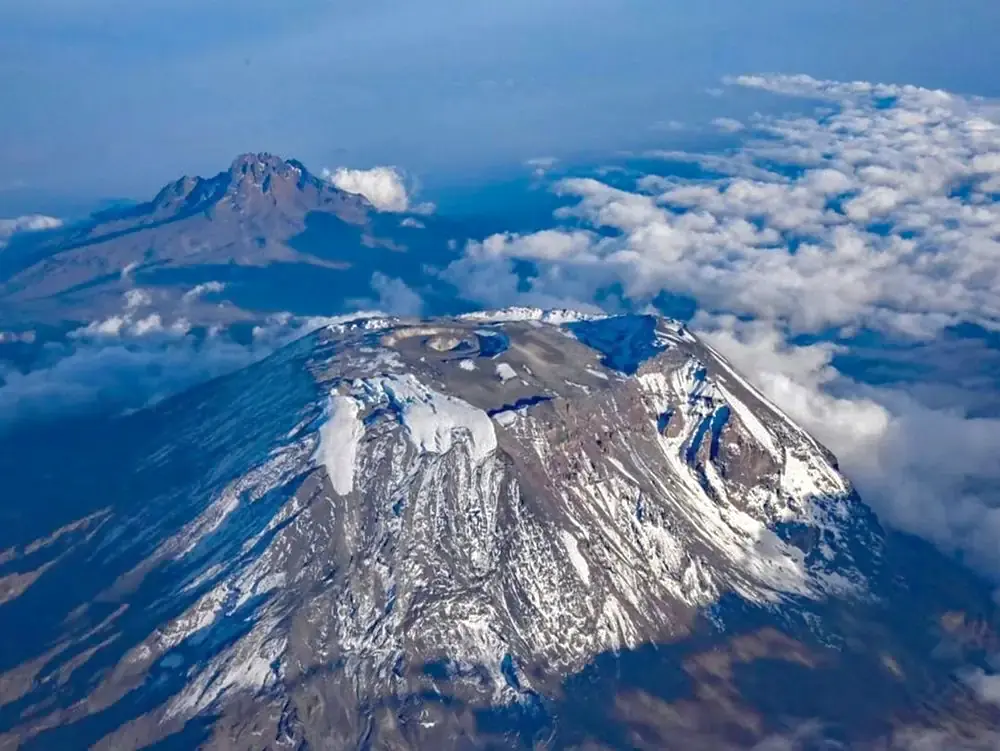
Mount Kilimanjaro is Located about three degrees or 206 miles south of the equator in the Kilimanjaro region, in northern Tanzania adjacent to the boundary of Kenya. Mount Kilimanjaro is one of the largest volcanoes in the world. It has three main volcanic peaks, Kibo 5895mt in the center , Mawenzi 5149mtrs in the east , and Shira 3962mtrs in the west . Its snow-capped peak and glaciers make it the highest mountain in Africa .
The mountain has five main vegetation zones from the lowest to the highest point: Lower slopes, montane forest, heath and moorland, alpine desert, and summit. The whole mountain including the Montane forest belt is very rich in species, in particular mammals, many of them endangered species. For this combination of features but mostly its height, it is the physical form and snow cap, and its isolation above the surrounding plains, Mount Kilimanjaro is considered an outstanding example of a superlative natural phenomenon.
Mount Kilimanjaro is a major tourist attraction for experienced and beginning climbers. To get to the mountain, the most convenient way is to fly into Tanzania (Kilimanjaro International Airport), and then travel to Arusha or Moshi, Kilimanjaro’s gateway towns, by vehicle. Both cities are approximately 50 minutes away from the airport and taxi services are readily available. Top Travel Safaris Adventure Tanzania offers expert travel planning and guides for getting here!
Usually, March, April, and May are the months with long rains and should be avoided.
In November and December, Tanzania’s short rainy season, it can be wet in the rainforest with snow toward the top of the mountain. However, clouds often disperse in the evening, allowing for excellent visibility in the night and morning. Climbers sometimes encounter violent storms with thunder and lightning in December, especially on the Northern and Western slopes of Mount Kilimanjaro .
The best times for climbing Kilimanjaro are the driest months of the year, especially Jan, Feb, and June—October offers reasonable chances of good, July can be colder, and January to February is the warmest months, with almost clear clouds each evening and morning.
There are six established routes to use while climbing Kilimanjaro. They vary in length and difficulty. All except one require you to camp. If you climb Kilimanjaro on the Marangu route your accommodation is in huts and camping is not allowed.
Five days are the absolute minimum duration for a Kilimanjaro climb, six Days are much better. If climbing using the Machame route six days is the minimum, seven days are recommended. Taking an extra day for acclimatization will greatly improve your chances to reach the summit. There are longer treks available for those who can afford them. Take a look at our Kilimanjaro Itineraries.

In the forest at lower elevations, you will experience hot and humid weather with temperatures around 15 to 25°C / 60 to 75°F. As you ascend on days 2 and 3, it can be dry and warm with temperatures around 10 to 18°C / 50 to 65°F. As you climb higher, temperatures will fall, Expect freezing temperatures at night. At the summit average daytime highs are about -4°C / 25°F with overnight lows around -10°C / 15°F, though it always feels much warmer in the sun and much colder at night. Wind chill temperatures can be as low as -18 to -12°C / 0 to 10°F.